In 2026, data is more valuable than oil, and big tech companies are hungry for it. If you are worried about your personal photos, chats, and documents being used to train corporate AI models, you need a solution. Searching for “how to build a private home AI server for data privacy in 2026” is the first step toward digital independence. At mobilecrc.com, we guide you through the process of taking back control.
1. Why You Need a Home AI Server
Most people use AI assistants that send every voice command to a central cloud. A private home AI server allows you to run “Local LLMs” (Large Language Models) right in your living room. Your data never leaves your house, and you get lightning-fast AI responses without an internet connection.
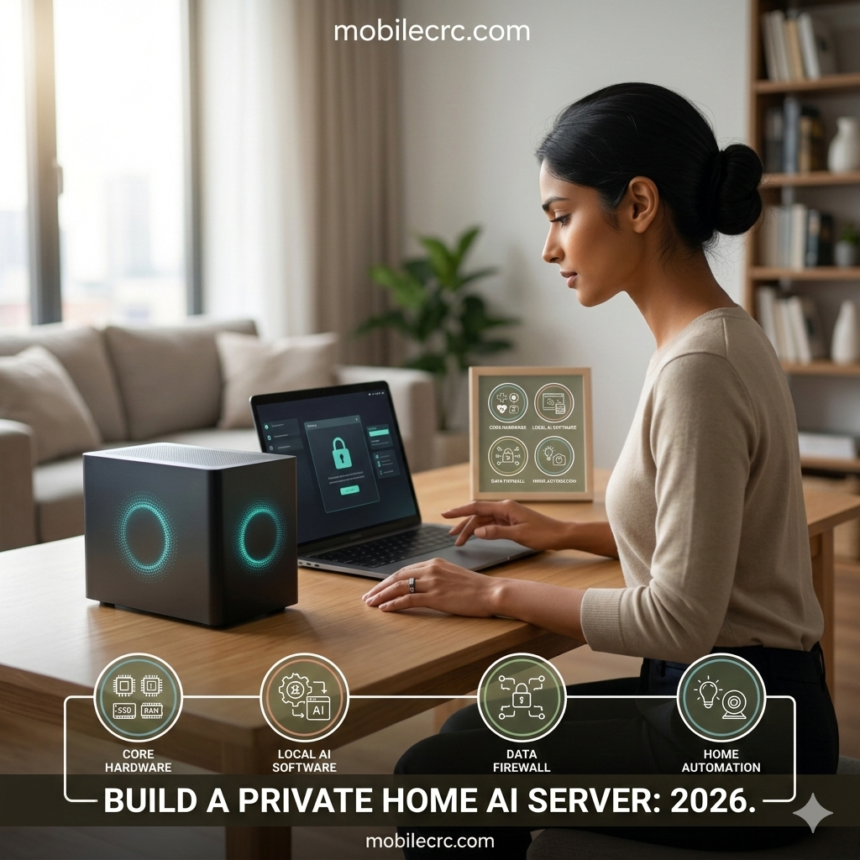
2. The Essential Hardware Stack
To start, you don’t need a supercomputer. For a solid 2026 setup, we recommend:
- Processor (CPU): Minimum 8-core modern processor.
- Graphics Card (GPU): At least 16GB VRAM (Crucial for running AI locally).
- Storage: 2TB NVMe SSD for fast data retrieval.
- RAM: 32GB or 64GB DDR5.
3. Choosing the Right Local AI Software
In 2026, software like Ollama, LocalAI, and LM Studio have made it incredibly easy to set up your “Private Brain.” These platforms allow you to download open-source models (like Llama 4 or Mistral) and interact with them just like you would with ChatGPT, but with 100% privacy. This is a key part of how to build a private home AI server for data privacy in 2026.
4. Setting Up a Secure Network (The Firewall)
A home server is only private if it’s secure. Use a “Tailscale” or “WireGuard” VPN to access your home AI from your phone while you are away, without opening your home network to the entire internet. At mobilecrc.com, we prioritize security over convenience every time.
5. Automating Your Home with Local AI
Once your server is up, you can connect it to your smart home devices. Imagine an AI that controls your lights and security cameras but doesn’t have a “backdoor” for hackers or corporations. This is the ultimate goal of building your own AI ecosystem.
Conclusion
Building your own server might sound technical, but in 2026, it’s as simple as assembling a PC. Learning “how to build a private home AI server for data privacy in 2026” is an investment in your future and your family’s security. Stay ahead of the tech curve with more guides at mobilecrc.com!